Why Your Industrial Investment Demands a “Zero-Error” Strategy in 2026
If you are a Nigerian entrepreneur or a corporate director based in Munich, Hamburg, or Stuttgart, you know that German engineering is the gold standard for your Nigerian factory. Whether it is a multi-million Euro bottling line, a modular refinery component, or heavy-duty construction excavators, the quality of your machinery is rarely the problem. The “bottleneck” is the 4,000-mile journey from the Port of Hamburg to the factory floor in Shagamu, Kano, or Port Harcourt.
In 2026, shipping Oversized (OOG) cargo to Nigeria is no longer a task for “freelance agents” with a laptop and a promise. The Nigeria Customs Service (NCS) has fully migrated to the National Single Window (NSW), and the Lekki Deep Sea Port has become the primary hub for heavy-lift project cargo. One documentation error on your Form M or a failure to secure a SONCAP Import Permit can result in your machinery sitting at the terminal for weeks, accruing millions in demurrage while your production line in Nigeria stands still.
At PKA Logistics Ltd, we specialize in “Project Logistics”—the art of moving the impossible. From our headquarters at 1 Warehouse Road, Apapa, we act as your licensed corporate bridge, ensuring your German machinery arrives ready to work, not stuck in a Customs query.
1. The Technical Breakdown: Understanding OOG and Project Cargo
Shipping industrial machinery often involves cargo that is “Out of Gauge” (OOG). This means the equipment is too wide, too tall, or too heavy to fit into a standard container.
A. Specialized Equipment Selection
- Flat Rack Containers: For machinery that exceeds the width or height of a standard box.
- Open Top Containers: For heavy equipment that must be loaded by crane from above.
- Breakbulk: For massive units (like turbines or silos) that must be secured directly onto the ship’s deck or in the hold.
B. The 2026 Regulatory Roadmap
To ship from Germany to Nigeria today, you must navigate three critical digital gates:
- SONCAP Import Permit: Most industrial machinery is exempt from offshore certification if you obtain a SONCAP Import Permit for “production machinery.” This is now processed exclusively via the National Single Window.
+1
- Form M & PAAR: Since January 2026, the Central Bank of Nigeria (CBN) requires all import documentation to be submitted digitally. We handle the Form M processing to ensure your exchange rate is locked and your PAAR (Pre-Arrival Assessment Report) is issued before the vessel hits the Atlantic.
- NAICOM Insurance: All project cargo must be covered by a Nigerian-registered insurance certificate (Marine Cargo Insurance).
2. Navigating the “Diaspora Pain Points”
The Fear of Hidden Port Charges
For industrialist’s abroad, the “hidden charge” is the silent killer of ROI. Freelance agents often fail to quote for terminal handling for heavy lifts or the specialized NPA (Nigerian Ports Authority) “Extra-Dimension” surcharges.
- The PKA Solution: We provide a transparent Landed Cost Estimate. We factor in the 2026 terminal rates at Lekki or Apapa so there are no “emergency” invoices during the clearing process.
The Risk of Damage and Vandalism
Machinery sensors and copper components are high-value targets for pilfering.
- The PKA Solution: We enforce “Rigid Securing” protocols. For OOG cargo, we oversee the lashing and tarpaulin covering in Germany and ensure the seal is inspected by our team the moment it berths at Tin Can Island or Lekki.
Shifting Government Policy (The “B’odogwu” Platform)
The NCS now uses the B’odogwu AI-driven clearing platform. If your HS Code (Harmonized System Code) is wrong, the system automatically triggers a “Red Lane” physical examination.
- The PKA Solution: We verify your machinery’s HS Code against the ECOWAS CET (Common External Tariff). We ensure you benefit from any “Machinery for Production” duty concessions, which can significantly lower your Nigeria customs duty compared to finished consumer goods.
3. The 2026 Logistics Comparison: Germany to Nigeria
| Feature | Standard Container (40ft) | OOG / Project Cargo (Flat Rack/Breakbulk) |
| Typical Machinery | Spare Parts, Small Lathes | Cranes, Silos, Production Lines |
| Clearing Hub | Apapa / Tin Can / Lekki | Lekki Deep Sea Port (Recommended) |
| Documentation | Standard Form M / PAAR | SONCAP Import Permit + EUC (if applicable) |
| Transit Time | 25 – 35 Days | 30 – 45 Days (Due to lashing/handling) |
| Safety Protocol | Sealed Box | Heavy-Lift Supervision + Lashing Audit |
4. The PKA Advantage: Why 1 Warehouse Road, Apapa?
Project logistics requires more than a desk; it requires a physical presence at the port’s “front line.”
- Oversight at the Source: Through our European partners, we can coordinate the pickup from your German supplier (e.g., in Berlin or the Ruhr region) to the port of Hamburg or Bremerhaven.
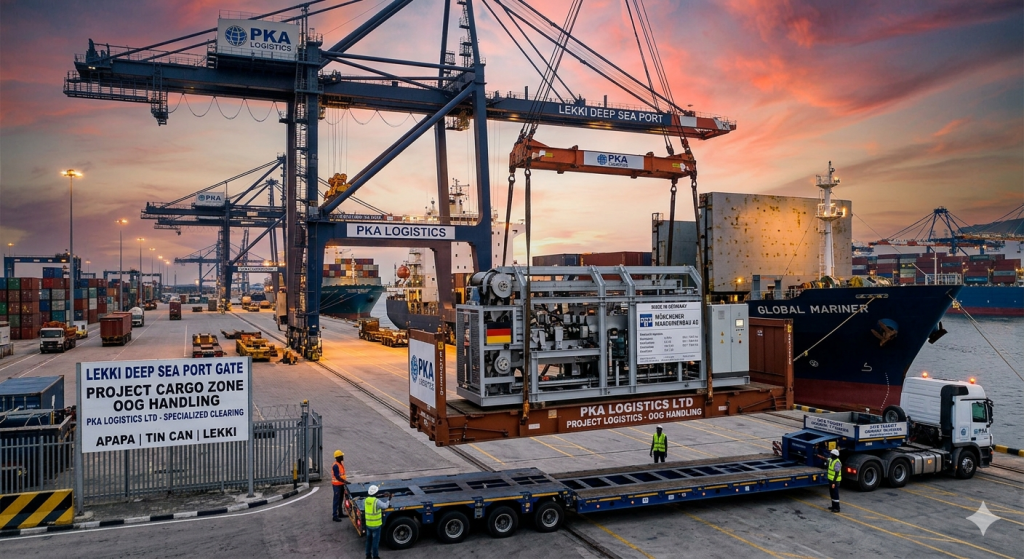
- Lekki Port Integration: In 2026, Lekki Deep Sea Port is the only port with the crane capacity to handle “Super-Heavy” OOG cargo efficiently. We have a dedicated team on-site at Lekki to manage the discharge and direct loading onto low-bed trailers.
- Specialized Inland Haulage: Moving a 50-ton machine through Nigerian roads requires more than a truck. It requires a Route Survey and Security Escorts. PKA Logistics manages the entire journey from the port to your factory gate.
5. FAQ: Shipping Industrial Machinery
Q: Can I ship used machinery from Germany? A: Yes, provided it is not “toxic waste.” However, used machinery must undergo a Physical Inspection at the port of entry. We recommend shipping “Refurbished” with a clear certificate to avoid Customs valuation disputes.
Q: How do I handle the “Form M” if I’m a Diaspora owner? A: We manage Form M processing for UK and European exporters via the trade portal. You provide the Proforma Invoice, and we handle the digital registration with your Nigerian bank and the CBN.
Q: Is the “VIN Valuation” applicable to industrial tractors? A: No. The VIN Valuation is for passenger and commercial vehicles. Industrial machinery is cleared under the CET tariff lines, which often carry lower duty rates to encourage industrialization.
Q: What is an End-User Certificate (EUC)? A: If your machinery has “dual-use” potential (e.g., certain high-capacity pumps or specialized drones), you may need an EUC from the Office of the National Security Adviser (ONSA). We advise you early if your cargo falls into this category.
Q: Why is Lekki better than Apapa for OOG cargo? A: Lekki Deep Sea Port has modern “Post-Panamax” cranes and a wider gate system, making it far safer for oversized cargo that would otherwise struggle with the narrow exits at the older Apapa terminals.
Conclusion: Partnering for Industrial Growth
Importing German machinery is a statement of intent for your business in Nigeria. Don’t let that intent be undermined by amateur logistics. Whether you are clearing a 40ft container in Lagos full of spare parts or moving a massive assembly plant, you need the corporate authority of PKA Logistics Ltd.
We understand the German precision you expect and the Nigerian reality we navigate. Together, we ensure your project is delivered on time, on budget, and in perfect condition.